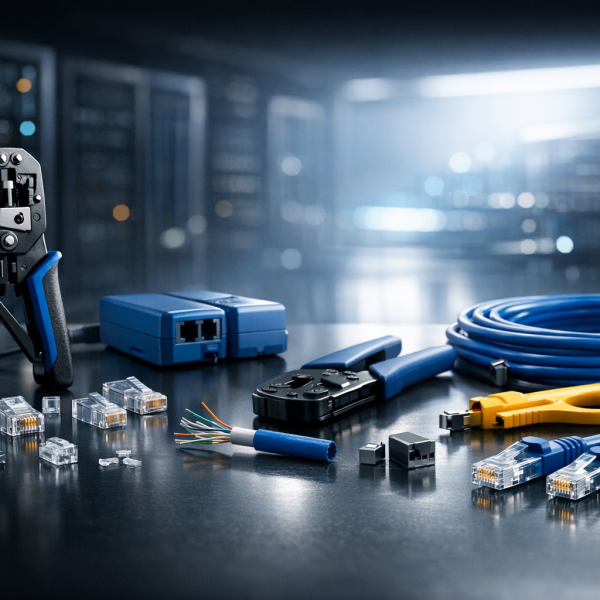
Working with Cat 6 cabling is no longer just about getting devices online. Modern networks demand low latency, reliable throughput, and clean, well-organized infrastructure that can scale. Whether you are wiring a home office, upgrading a business network, or preparing a studio for high bandwidth media, the difference between a mediocre and a high performing installation often comes down to how confidently you use your tools.
1. Understand the Core Cat 6 Toolset Before You Start
Before pulling a single cable, make sure you can identify every essential tool and what role it plays. At a minimum, you will want a cable tester, wire stripper, crimping tool, punch down tool, cable jacket cutter, and a reliable labeling system. Add a tone generator and tracer for larger projects, plus a cable comb for managing bundles. By knowing exactly which tool is needed at each stage, you avoid guesswork, reduce waste, and keep your install speed consistent from the first drop to the last.
2. Prioritize Quality Tools Over Bargain Kits
Low quality tools often result in weak terminations, damaged cable jackets, and intermittent faults that are almost impossible to diagnose once the walls are closed. Invest in hardened steel blades for strippers and punch down tools, ratcheting crimpers that guarantee full pressure, and testers that can certify performance up to the full Cat 6 specification. The long term savings from fewer callbacks, higher throughput, and reduced troubleshooting time more than justify the initial cost. When you choose reliable equipment and pair it with strong online visibility through strategies like backlinks for seo, you also position your installation business as the go to option for demanding networking projects.
3. Learn to Use a Cable Tester as Your First and Last Step
Testers are often treated as an afterthought, but they should bookend every phase of a project. Use a basic continuity check before and after pulling runs to confirm that the cable has not been kinked or damaged. Once terminations are complete, run a full test including wiremap, length, and performance at minimum frequency levels. Certification testers can validate that your work actually meets Cat 6 performance standards, which is especially vital in data centers and high density office environments.
4. Master Precise Stripping Without Damaging Twisted Pairs
The cable jacket must be removed cleanly while preserving the twist integrity of the internal pairs. Set your stripper depth so it cuts only the jacket, then rotate smoothly without applying side pressure that compresses the cable. Once the jacket is off, keep untwisting pairs to the absolute minimum required by the connector specification. Excessive untwisting introduces crosstalk and can degrade signal quality long before you reach the theoretical length limit of the cable.
5. Use Crimping Tools with a Consistent, Repeatable Technique
Whether you are terminating modular plugs or keystone jacks, consistency is critical. Always trim conductors to a uniform length, verify the correct pinout (T568A or T568B) before seating them, and ensure each conductor reaches the end of the connector channel. A ratcheting crimper should not release until full compression is applied; if it does, your terminations will vary in quality. Practice on scrap cable and evaluate your results with a tester until you can produce flawless crimps repeatedly.
6. Optimize Punch Down Skills for Patch Panels and Jacks
Punch down tools must cut cleanly, fully seat the conductor, and avoid nicking the copper. Set the impact level appropriate to your hardware and cable type; too little force leads to poor contact, while too much can damage terminals. Always hold the tool at a true perpendicular angle to the block, and follow the color codes printed on jacks and panels closely. After punching down a row, gently tug each conductor to verify mechanical integrity before closing up the panel.
The point about Cat 6 tooling is that the standard is only as good as the equipment used to terminate it, and shortcuts show up as intermittent faults months later. Household finances have the same property: the framework is simple, and the failures come from the instruments used to keep track. Choosing personal finance software is that decision in miniature, because the tool decides how much visibility you actually get.
7. Use Cable Management Tools to Maintain Performance
Velcro straps, cable ties with appropriate tension, ladder racks, and horizontal managers are not just for aesthetics; they protect bend radius, ventilation, and future scalability. Avoid over tightening any restraint that compresses the cable, as this can disturb the internal geometry and impact signal quality. Plan your paths before pulling, and use cable combs to keep bundles neat as they move through trays and conduits. A disciplined approach here makes upgrades, repairs, and expansions dramatically easier.
8. Implement Labeling and Documentation From Day One
Premade labels, heat shrink markers, and clear labeling standards are as essential as your physical tools. Assign unique IDs to each run, document both endpoints, and update maps as you go. Digital diagrams tied to QR codes at racks or cabinets can accelerate future troubleshooting. Well documented installations save hours when clients need changes, and they demonstrate a level of professionalism that sets you apart from less organized competitors.
9. Respect Bend Radius and Pulling Tension
Even the best tools cannot save a cable that has been crushed around a tight corner or pulled with excessive force. Use cable rollers or pulleys where necessary, obey manufacturer guidelines for maximum pulling tension, and maintain generous radii at all directional changes. Check that conduits are not overcrowded and that bundle weight is evenly supported along its path. These practices help preserve signal integrity and prevent mysterious performance problems later.
10. Combine Tools with Workflow Planning for Maximum Speed
Speed on high bandwidth projects comes from a well defined workflow, not from rushing individual steps. Stage your tools according to the project phases: rough in, termination, testing, and documentation. Use tool belts, carts, or portable cases so that every device has a defined place and can be reached without searching. For larger jobs, standardize procedures across your team, train new technicians on your exact tool methods, and create checklists for each project milestone.
Turning Tools into Long Term Performance
High speed Cat 6 installations succeed when every tool is used with intention. From precise stripping and accurate punch downs to thorough testing and clean cable management, your methods directly determine whether a network simply functions or delivers peak, reliable performance. By investing in quality tools, mastering their operation through practice, and integrating them into a disciplined workflow, you transform each project into a durable, scalable asset that can handle demanding applications for years to come.